How is Big Data Different from Traditional Data?
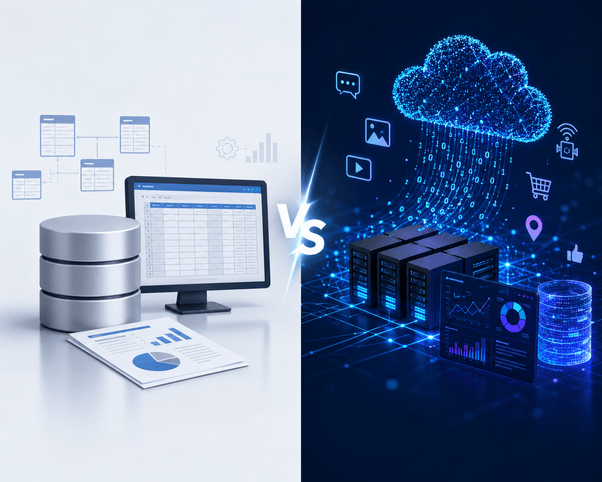
Today's corporations create enormous amounts of information at every moment due to their dealings with customers as well as their website visits, social media use, Internet of Things usage, and much more. This information explosion has created new challenges in regard to collecting, processing, and analyzing corporate information. Big data differs from traditional data because it can handle massive volumes of structured and unstructured information generated at high speed, while traditional data systems are mainly designed for smaller, structured datasets stored in relational databases. Big data technologies also enable real-time processing and advanced analytics, helping businesses uncover deeper insights and make faster decisions. Businesses are also increasingly exploring data warehouse benefits to store and manage growing data efficiently for better analytics and reporting. It means that the discussion about big data versus traditional data has never been more pertinent.
Traditional databases have successfully helped organizations cope with structured information for several decades; however, modern companies deal with such large and fast information flows that they cannot process them properly using the tools available to them.
In this guide, we’ll explore the major differences between traditional data and big data, compare traditional analytics vs big data analytics, discuss real-world applications, and explain which approach is best for modern businesses.
What is Traditional Data?
Traditional data is termed as that type of data that is structured and is found in relational database management systems such as SQL databases.
Examples of Traditional Data
- Customer records
- Sales reports
- Payroll systems
- Inventory databases
Features of Traditional Data
- Structure format
- Centralized data storage
- Scalability issues
- Batch process
What is Big Data?
Big data refers to extremely large and complex datasets that traditional systems cannot process efficiently. It involves structured, semi-structured, and unstructured data obtained from several digital sources.
Examples of Big Data Sources
- Social media sites
- IoT gadgets
- E-commerce activities
- Mobile applications
- Video streaming sites
Features of Big Data
- Large-scale data volumes
- Real-time processing
- Distributed storage systems
- Sophisticated data analysis tools
Big Data vs Traditional Data
This comparison clearly explains the difference between big data vs traditional data in modern businesses.
Traditional Analytics vs Big Data Analytics
Analytics is another major area where both systems differ.
Traditional Analytics
Traditional analytics focuses on historical structured data and predefined reports.
Used For
- Preparation of financial reports
- Management of inventory
- Operations carried out on a daily basis
Looking to modernize your data strategy?
HeadToNet helps businesses build scalable analytics solutions. Whether you need better reporting, real-time dashboards, or advanced analytics capabilities, our experts can help you design the right approach for your business.
Contact Us
Big Data Analytics
The big data analytical tools analyze data sets in real time to identify patterns and trends and even provide future predictions. Businesses following a data maturity model are often better equipped to leverage advanced analytics technologies and improve data-driven decision-making.
Used For
- Customer behavior analysis
- Fraud detection
- Recommendation personalization
- Machine Learning & Artificial Intelligence
In comparing traditional analytics and big data analytics, the latter is more efficient and provides better business intelligence.
Advantages of Traditional Data
- Easy to manage
- Highly organized
- Cost-effective for smaller businesses
- Reliable for transactional systems
Advantages of Big Data
- Handles massive datasets
- Supports real-time decision-making
- Improves customer experience
- Enables predictive analytics
Challenges of Traditional Data
- Cannot handle unstructured data efficiently
- Limited scalability
- Slower processing speed
Challenges of Big Data
- Requires advanced infrastructure
- Higher implementation costs
- Complex data management
Which One is Better?
Conventional data platforms are effective in processing structured and small volumes of data, whereas big data platforms are suitable for enterprises that process large volumes of data.
In modern companies, it is common practice to use both data platforms simultaneously.
Transforming Data into Smarter Business Decisions with HeadToNet
HeadToNet is an analytics and data solutions firm that offers its clients help in turning their data into insights using its services. The company offers its clients support on issues such as database management and deployment of big data systems, helping firms become more efficient in decision-making.
Thanks to the expertise in data analysis, cloud services, and business intelligence, the company will be able to provide their clients with assistance in using data and big data platforms to optimize their performance in the market using an ai business analytics solution tailored to business needs.
Final Thoughts
Understanding big data vs traditional data is essential for businesses looking to improve analytics and operational efficiency. While traditional systems remain important for structured information, big data technologies provide real-time insights and advanced analytics capabilities.
Similarly, the shift from traditional analytics vs big data analytics shows how businesses are moving from basic reporting toward predictive and AI-driven decision-making.
Ready to transform your data into business growth?
Connect with our team to explore how your business can leverage traditional and big data technologies more effectively.
Contact Us
StackAudit Offer