Marketing Campaign Workflow: Steps & Template
.jpg)
It is necessary that you have a well-structured Marketing Campaign Workflow which is essential for ensuring that your marketing campaigns are well-planned and performed properly, even at a larger size. Let’s have a look at a marketing campaign workflow, choose a template to use and see some instances of marketing campaign workflows.
What Is a Marketing Campaign Workflow?
A Marketing Campaign Workflow can be defined as the process of advancing the marketing campaign from concept formulation through to analysis. This will make sure that all procedures engaged in the marketing initiatives are in sync. The goal of this workflow is to establish a simple repeatable process to improve efficiency and effectiveness.
As your campaigns go up, you might want to automate key portions of your workflow to save time. That’s where marketing automation workflows come in. Automation is good for things like email sequences, targeting ads, creating reports, and so on.
Steps in a Marketing Campaign Workflow
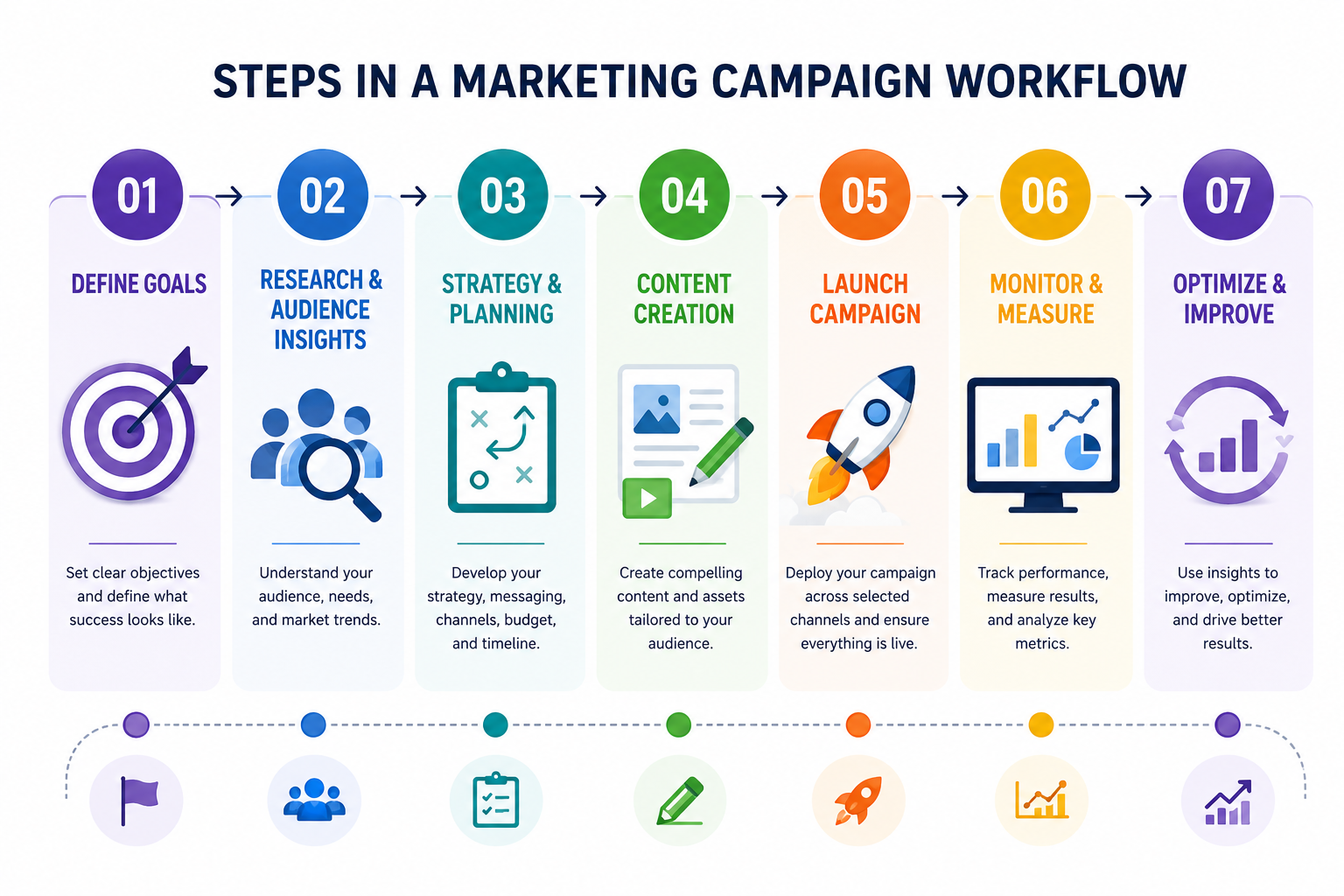
1. Define Campaign Goals and KPIs
At the commencement of campaigns, the correct goals should be set. Whatever you want to generate leads, increase traffic or boost revenue, be sure your objectives are measurable. This will allow you to more easily track your progress and see if your campaigns are successful or not.
2. Identify Your Target Audience
It's crucial to know your target demographic before starting a campaign. You need to segment your prospects by demographics, behaviours and issues.
3. Create Your Marketing Assets
Now that you have defined your target, you can begin to generate the appropriate material. It could be advert creatives, email templates, landing pages for your website, or even generating blog content.
4. Launch the Campaign
Now that you have all the materials you need, you can start your marketing campaign on all the channels you chose such as email campaigns, paid advertising campaigns, social media marketing campaigns and more.
5. Monitor Campaign Performance
You must monitor KPIs such as CTR, conversion rate, and overall engagement during the campaign. That will enable you to identify and resolve any challenges that you may face during the campaign.
6. Optimize the Campaign
Utilize the performance analytics to guide your campaign modifications. The performance metrics need to be better.
7. Analyze Results and Gather Insights
Lastly, when the campaign is over you need to evaluate whether you achieved your goals. Record what was learned and might be beneficial to optimize future efforts. Constant improvement is the secret to optimizing the workflow process.
Marketing Campaign Workflow Examples
Here are some examples that explain how to implement the stages discussed above:
Example 1: Lead Generation Campaign
- Goal: Reach 500 leads
- Steps:
- Target the desired market segment (small business owners, for example)
- Develop landing pages with lead generation forms
- Setup email marketing campaigns
- Launch paid campaigns through Google and LinkedIn
- Monitor campaigns and fine-tune the targeting
- Send emails to follow up
Example 2: Product Launch Campaign
- Purpose: To boost product awareness and sales
- Workflow:
- Develop a product launch plan
- Develop marketing material (blog articles, social media, email)
- Run targeted advertising that bring traffic to the launch page.
- Monitor engagement and track sales
- Real-time data for ad design and messaging optimization
Streamline Your Campaigns with HeadToNet
HeadToNet, manage your marketing campaign workflows.
Get in touch
Template for Marketing Campaign Workflow
To get you started, here’s a simple template:
Phase 1: Strategy
- Set campaign goals
- Define your audience
- Build messaging
Phase 2: Planning
- Design assets (ads, emails, landing pages)
- Set due dates
- Create tracking systems
Phase 3: Execution
- Launch on selected channels
- Watch performance in real time
- Aligning teams
Phase 4: Optimization
- Change ad creatives
- Refining the target
- Change budget distribution
Phase 5: Retrospective
- Measure success versus KPIs
- Document lessons learned.
- Get ready for the next campaign
The Role of Marketing Automation Workflows
As campaigns scale, manual workflows become inefficient. It is then that marketing workflow comes into play. Workflow will help in automating processes such as:
- Sending follow-up e-mails
- Nurturing leads
- Generating performance reports
Through this automation, marketing departments can concentrate on strategic planning rather than daily execution of processes.
Final Thoughts
By having a proper workflow in your Marketing Campaign, you are creating the basis for being able to run efficient marketing campaigns. With these steps you will be able to make sure that your campaigns are running smoothly all the way through and achieve tangible results. A solid workflow will enable you to stay organized and efficient when either sending out emails or promoting new products.
Want to Optimize Your Campaign Workflow?
Ready to develop a Marketing Campaign Workflow that works? Then it’s time to get moving.
Get in Touch
StackAudit Offer