What Is Data Automation and Why Businesses Need It
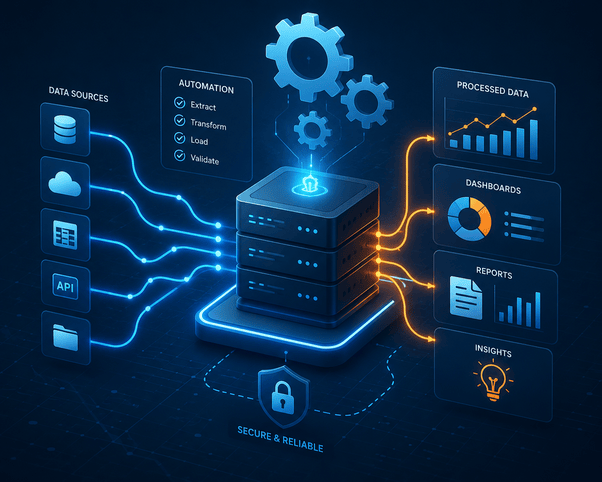
Businesses currently generate a lot of information everyday from consumer interactions, sales platforms, operational systems, and digital media. Doing it manually might slow down processes, cause mistakes and reduce efficiency. That’s why data automation has become a must-have for organizations looking to boost productivity, scalability and decision-making. Experienced data engineering consulting services can help build scalable automation systems to help sustain long-term growth for the business.
Today, companies are deploying smarter technology to automate laborious operations, centralize information and broaden access to real-time data. Intelligent automation solutions allow companies to eliminate operational bottlenecks and increase overall business performance.
What Is Data Automation?
Data automation is the use of technology to capture, organize, transform, and analyze data without the continuous involvement of humans.
Automation solutions shift the information from one platform to another appropriately and efficiently rather than tedious administrative procedures and spreadsheets. Automation makes firms better by:
- operational reporting
- customer analytics
- workflow management
- financial reporting
- business intelligence
- enterprise decision-making
The aim is to develop faster, more scalable and more accurate techniques.
Why Businesses Need Data Automation
Organizations that rely heavily on manual processes often experience:
- inconsistent reporting
- fragmented systems
- faults in operation
- increased administrative costs
- delay Business Insights
- repetitive information
The main advantage of automating data processing is the possibility of excluding manual repetitious processes, while at the same time achieving higher speed and operational regularity. Automated solutions can also help companies respond more effectively to customer requests and shifting market conditions.
Automation of infrastructure upgrading helps firms create collaboration, speed up reporting and simplify internal procedures within divisions.
How Data Automation Works
The modern automation systems are built on a systematic strategy that improves the way firms manage information through portals.
Data Collection
Information from:
- Crm systems
- Websites
- ERP Systems
- Cloud Apps
- Ecommerce Systems
- Analytics platforms.
Data Integration
Data comes from various sources and is arranged in a linked ecosystem, which enhances its accessibility and visibility.
Data Transformation
Transformation of data takes place, whereby the data is formatted and standardized.
Data Processing
Automation processing is based on predefined rules, whereby the information is processed quickly and effectively.
Reporting and Analytics
Through dashboards and reporting, one can be able to make decisions that concern the corporation.
Benefits of Data Automation
Increased Efficiency
Automation cuts down the time staff spend on repetitive administrative tasks and manual reporting processes.
Improved Data Accuracy
Manual workflows often lead to:
- Duplicate Records
- Format Error
- Lack of information
- Conflicting information
Consistency and reliability of corporate systems are assured via automation.
Faster Business Insights
Organizations may employ real-time analytics and operational information to make faster, better decisions.
Better Scalability
As firms grow, these automation technologies help process more information without a significant increase in operating costs.
Improved Customer Experiences
More data and workflow visibility can improve customer interactions and operational response.
HeadToNet to boost your operations
HeadToNet helps organizations construct scalable automation systems, analytics platforms and enterprise integration solutions that improve operational performance and long-term scalability.
Contact Us
The Role of Data Warehousing in Automation
Successful automation programs demand a consolidated data infrastructure. The increasing data warehouse benefits may lead to greater reporting accuracy, operational insight and enterprise analytics capabilities for businesses.
Modern data warehouses support .
- Consolidated reporting
- Rapid analytics
- Real-time dashboards
- Enterprise scalability.
- Streamlined automation procedures
- Improved business intelligence
With a good data infrastructure, integrated and reliable information systems may help businesses make smarter strategic decisions.
Common Challenges Businesses Face
Despite the various advantages, there are certain issues that may arise in case an organization implements automation technology.
Incompatible Infrastructure
The current infrastructure might prove to be incompatible with the newly implemented automation technology.
Data Silos
The use of different technologies might cause problems in reporting and process workflows.
Security and Compliance
It is important for companies to ensure that their automated systems and connections are secure and compliant.
Bad Data Quality
Good-quality data is important for the effective implementation of automation technology.
Change Management
Digital transformation initiatives often require training and operational assistance.
What Is a Data Automation Tool?
A data automation tool is a software that is used to automate the procedures of collecting, processing, integrating and analysing business information.
These tools help organizations:
- reduce manual work loads
- co-ordinate systems.
- Automate processes
- Centralize the analysis
- Improve report generation efficiency
Commonly utilized automation technologies are:
- ETL tools
- Cloud integration tools
- Analytical dashboards
- Workflow automation software
- Enterprise reporting tools
The selection of the right automation platform is defined by:
- Business objectives
- Scalability
- Integration complexity
- Security considerations
- Operations
How Automation Supports Marketing Operations
Automation helps with consumer engagement and digital marketing efforts as well. Marketing automation flows can help businesses improve lead nurturing, customer segmentation, campaign reporting, and the customization of communications.
Integrated automation solutions offer marketing departments:
- performance improvement in marketing
- data consolidation for customers
- reporting automation
- customer journey optimization
- conversion tracking improvements
The features of automation, analytics, and reporting allow businesses to better understand customer behavior and their performance.
The Rise of Automated Data Solutions
Many firms nowadays are leaning towards automated data solutions for greater operational scalability and for the purposes of digital transformation.
These solutions enable companies to:
- cut down operational inefficiency
- consolidate company information
- increase visibility of workflows
- make reporting better
- enable AI analytics
As AI and cloud technologies continue to develop, automation will be an increasingly critical factor in fueling company development and operational agility.
Why Businesses Choose HeadToNet
HeadToNet helps enterprises modernize their infrastructure with corporate automation, analytics and smart integration solutions.
They have expertise in:
- enterprise automation
- workflow streamlining
- operational modernization
- cloud integration
- infrastructure analytics
- business intelligence solutions
HeadToNet blends technology strategy with scalable automation solutions to help companies drive productivity, reduce operational complexity and accelerate digital transformation efforts.
HeadToNet – Improved Operations
HeadToNet is a leading provider of customized corporate automation and analytics solutions that help companies streamline operations, modernize infrastructure and grow more efficiently.
Contact Us
StackAudit Offer