Data Governance Maturity Model Framework: Stages & Benefits

Businesses now create more data than ever before, but most have trouble turning it into measurable commercial value. A data maturity framework helps businesses understand how effectively they manage, govern, and use data to drive decisions, innovation, and competitive advantage. Many organizations also rely on data engineering consulting services to build scalable and reliable data foundations that support this journey.
Understanding your current position through a structured data maturity framework assessment is the first step toward improving analytics capabilities, AI readiness, governance strength, and long-term scalability. We'll explain what a data maturity model is, how to evaluate your business, and how to go from scattered data activities to a structured transformation roadmap in this guide.
Understand Where Your Data Stands Today
[ Request a Data Maturity Assessment ]
What Is a Data Maturity Model?
A data maturity model is a framework that helps organizations assess how effectively they manage data across strategy, governance, technology, analytics, and culture.
It helps answer critical questions like:
- Can we trust our data?
- Are decisions data-driven or based on intuition?
- Is our data architecture scalable?
- Are we ready for AI?
- Is governance proactive or reactive?
A data maturity framework helps organizations benchmark capabilities and identify gaps across key areas, including the data governance maturity model, which evaluates how well data integrity, security, and compliance are maintained.
Why Data Maturity Models Matters
Many businesses invest in dashboards, AI tools, and cloud platforms but fail to achieve expected outcomes. The issue is rarely technology it’s the lack of a structured data maturity framework.
Benefits of High Data Maturity for Analytics and AI
High-maturity organisations open up:
- Using predictive analytics
- Business intelligence in real time
- Large-scale AI implementation services
- Strong security and compliance stance
- Data alignment across functions
- Cloud data modernisation that can grow
Data maturity is the basis for long-term competitive differentiation and enterprise AI strategy consultation.
Key Components of a Data Maturity Model
Most mature frameworks look at organisations on 5 to 6 main levels.
Data Strategy and Leadership
- A clear vision for data that fits with corporate aims
- Executive sponsorship (CDO or CTO ownership)
- Set KPIs for data ROI
Maturity stalls without leadership alignment.
Data Governance and Quality
- Set up data owners and stewards
- Standardised meanings
- Frameworks for monitoring quality
- Processes for compliance
This is where a strong data governance maturity model plays a critical role in ensuring consistency and trust in data. Poor data quality at this stage can significantly impact decision-making, which is why understanding issues like those discussed in How to Fix Poor Data Quality in Business becomes essential.
Data Architecture and Technology
- Architecture for a data pipeline that can grow
- Infrastructure that is ready for the cloud
- Solutions for data warehouses
- Systems that can work together
Businesses today need to combine data modernisation services with changes to their architecture.
Security, Privacy, and Compliance
- Controls for access
- Being ready for regulatory compliance
- Models for classifying data
- Monitoring security
This is very important in fields like finance and health care that are regulated.
Analytics, Skills, and Data Culture
- Using self-service BI
- Putting together AI analytics solutions
- Teams of skilled analysts
- Culture based on data
Culture generally plays a bigger role in maturity than tools do.
Common Data Maturity Levels
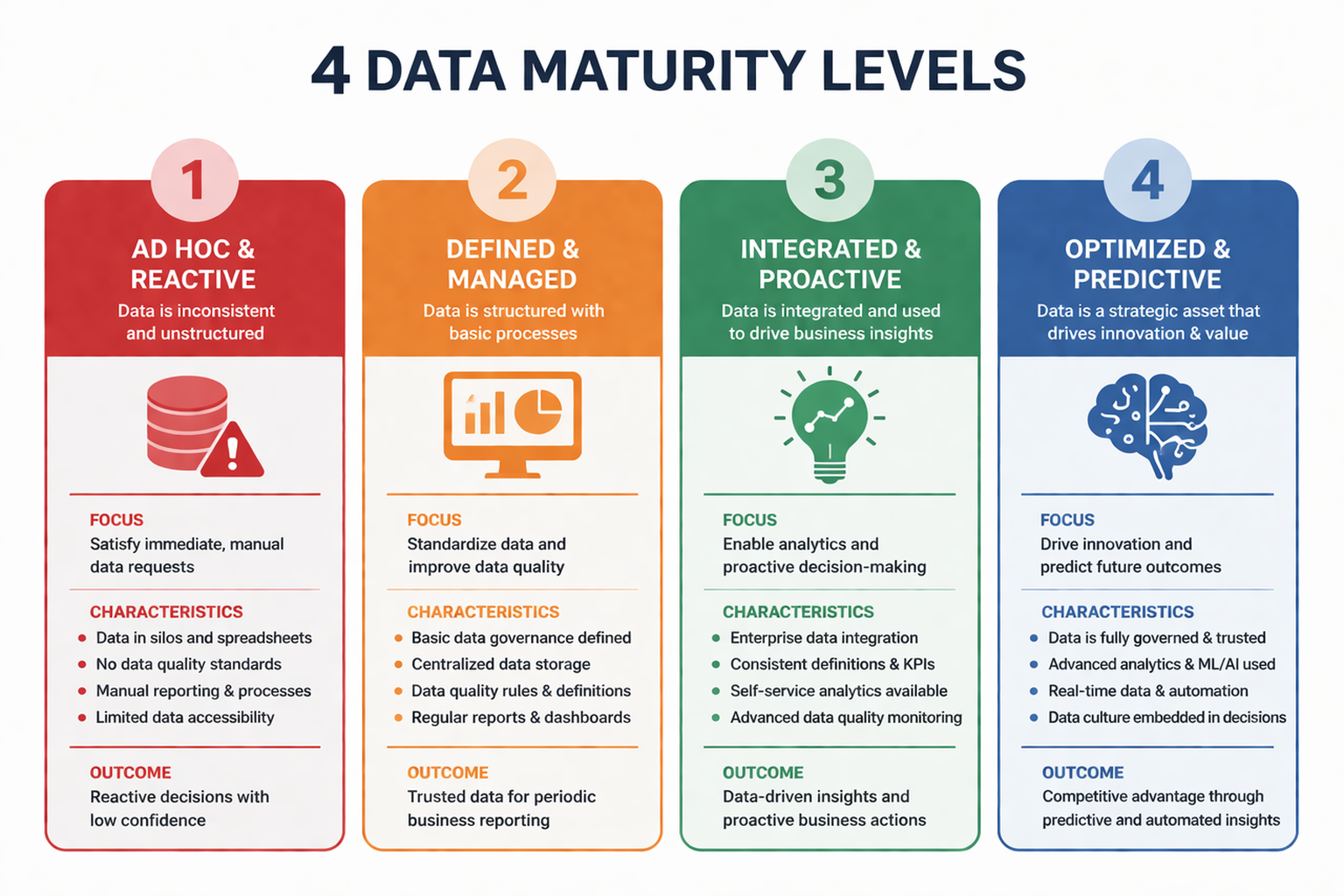
Most frameworks for data maturity have 4 to 5 stages.
1. Initial (Ad Hoc)
- Data in silos
- Reporting by hand
- No official rules
- Making decisions based on what happens
2. Developing
- Some systems that are centralised
- Policies for early governance
- Simple dashboards
- Not much predictive analytics
3. Defined
- Documented plan for data
- Standardised ways of doing things
- More mature governance and BI use across teams
4. Optimized
- Analytics in real time
- Monitoring the quality of data automatically
- AI built into operations
- Cycles of constant innovation
Without organised advisory help, very few organisations attain their full potential.
How to Assess Your Organization’s Data Maturity
A good data maturity evaluation should be organised, involve people from different departments, and be fair.
Step 1: Evaluate Current Capabilities
Check:
- Aligning strategies
- Documents for governance
- Stack of technologies
- Using analytics
- AI use cases
- The way an organization is set up
A data maturity model scorecard can help you figure out how much each dimension is worth.
Step 2: Score Maturity Across Key Dimensions
Give maturity scores (1–5) in the following areas:
- Plan
- Governance
- Architecture and Analytics
- Safety in Culture
This shows that there are imbalances in maturity, such powerful technology and inadequate governance.
Step 3: Identify Gaps and Improvement Areas
After scoring, define:
- Quick wins
- High-impact change priorities
- Roadmap for changing data throughout time
This path connects the current condition to the future of scalable modernisation.
How HeadToNet Helps Organizations Improve Data Maturity
It's not about getting tools to get better. It's about changing in a planned way.
Interpreting Data Maturity Assessment Results
A lot of businesses get the wrong idea about performance when they merely look at technology gaps. To really improve maturity, you need:
- Alignment of strategies
- Putting governance into practice
- Updating architecture
- Allowing analytics
Structured diagnostics help businesses figure out where to put their money.
Turning Results into a Roadmap
A transformation roadmap usually has:
- Modernising data in the cloud
- Redesign of the data pipeline architecture
- Putting in place a governance framework
- Services for implementing AI
- Support for business intelligence consulting firms
This is where a structured data governance maturity model approach becomes critical to accelerating ROI and ensuring sustainable growth.
Ready to Benchmark and Build a Transformation Roadmap?
[ Schedule a Consultation ]
Role of Data Governance in Data Maturity Model
Data governance is the backbone of any robust data maturity framework. It ensures that data is accurate, accessible, and secure, providing a foundation for effective decision-making and AI implementation.
How Governance Enables Trusted Data
- Sets up ownership
- Makes data better
- Lessens conflicts in reporting
- Ensures compliance
Analytics can't grow reliably without governance maturity, making the data governance maturity model an essential part of your overall data strategy.
Common Governance Challenges
- Not getting executives on board
- Undefined data ownership
- Overly complicated frameworks
- Resistance to change
Mature organizations simplify governance instead of overcomplicating it.
Best Practices to Improve Data Maturity
Improvements should be strategic. It should not be reactive.
1. Start with High-Impact Use Cases
Focus on:
- Finance business intelligence
- Predictive Analytics Consulting Initiatives
- Customer 360 Implementation
- Revenue forecasting
Winning early generates executive trust.
2. Align People, Process, and Technology
True maturity requires:
- Leadership alignment
- Cross-functional collaboration
- Clear data accountability
- Modern architecture
- AI-based business intelligence integration
Without alignment of the process, technology implementation is not successful
Final Thoughts
A data maturity model is not a checklist to prove compliance. Rather, it is a strategy-based diagnostic tool that identifies whether you are able to thrive in a data-driven economy.
While the organizations that focus on improving the maturity of their data, they tend to excel more than their peers do. On the other hand, organizations that fail to take this change seriously get stuck.
If your organization is unsure where it stands, conducting a structured data maturity assessment is the most practical first step toward scalable modernization.
Turn Data Maturity Into Competitive Advantage
[ Contact Us ]
FAQs
What is a data maturity model used for?
It evaluates how effectively an organization manages, governs, and uses data to drive business value, analytics, and AI adoption.
How long does a data maturity assessment take?
Typically 4-8 weeks depending on organizational size, complexity, and cross-functional involvement.
Is data maturity only about technology?
No. It includes governance, leadership, strategy, culture, architecture, analytics capability, and security.
How often should organizations reassess data maturity?
Ideally every 12-18 months to track progress and align with transformation initiatives.
StackAudit Offer