6 AI Business Analytics Solutions That Actually Deliver Business Value

The amount of money companies are spending on new AI analytics and business analytics using AI is significant, but many companies struggle to use their findings to create measurable outcomes. It is the approach to analytics projects that makes the difference between experimentation and impact. When applied to a particular business objective, AI systems go beyond dashboards and begin to impact revenue growth, operational efficiency, and competitive differentiation.
This tutorial will cover six proven approaches that always deliver value to a business, not just hype.
What Is AI Analytics and Why Business Value Matters
Artificial intelligence analytics is the application of machine learning, natural language processing, and automation to examine large amounts of data, identify patterns, and develop valuable information. An effective AI business analytics solution is not like static reporting tools it continuously learns from new data, becoming more accurate and valuable over time.
But the result, not the method, is what really sets them apart. When analytics projects are linked to key performance indicators (KPIs) like increasing revenue, lowering costs, lowering risk, or keeping customers, they add value to the business. Without proper alignment, even the most advanced platform turns into a costly reporting layer.
Companies that regard analytics as a strategic skill rather than a way to improve technology get better results and get teams to use it faster.
6 AI Analytics Solutions for Business 2026
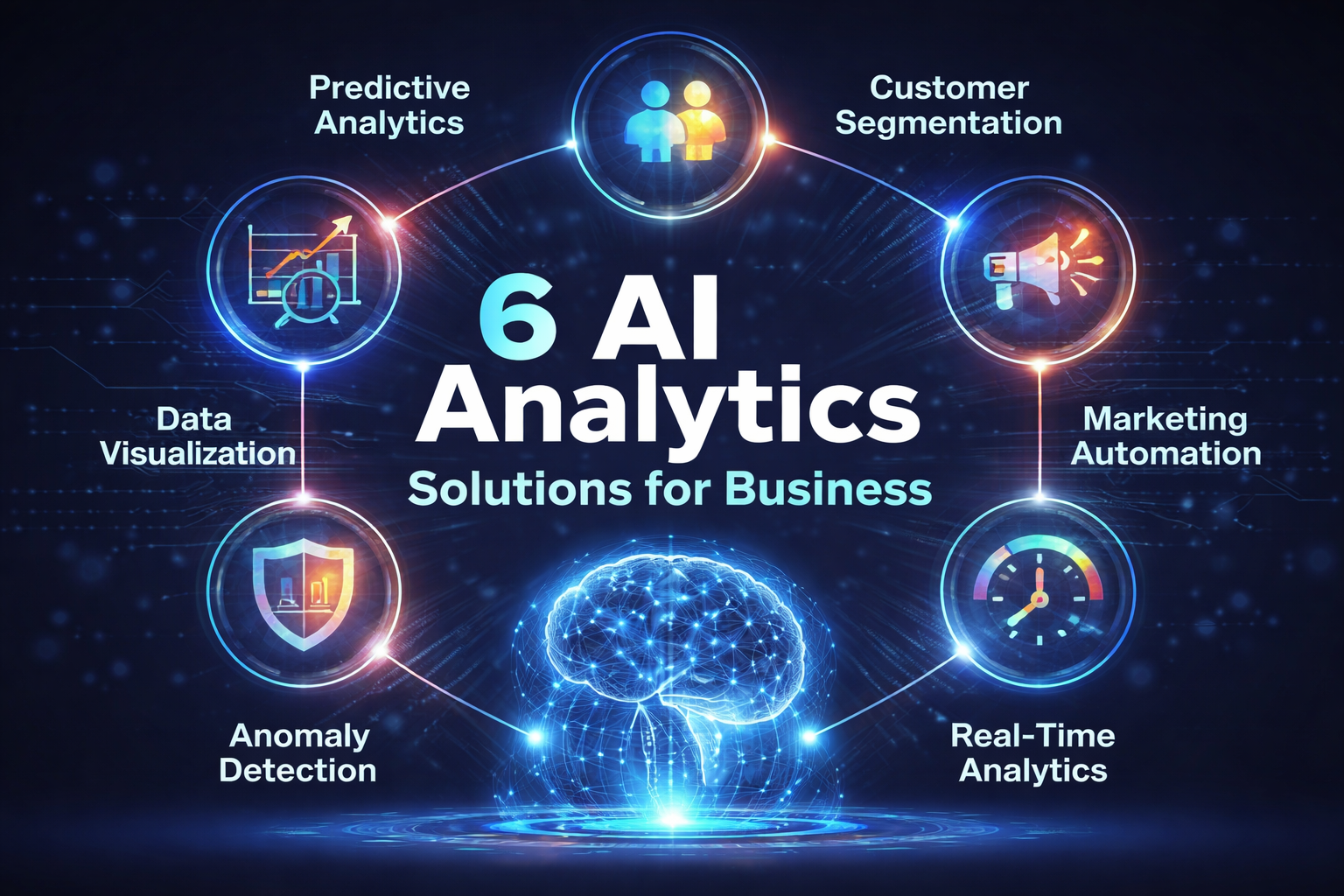
1. Predictive Analytics for Revenue & Demand
Predictive analytics looks at past data, patterns of behaviour, and outside signals to guess what will happen in the future. Some such uses are:
- Predicting sales
- Planning for inventory
- Changing prices
- Predicting customer churn
With the help of predictive analytics consulting, businesses can build a tailored AI business analytics solution aligned with their revenue model and market dynamics.The result is more accurate forecasts and more secure capital allocation.
Predictive solutions help businesses with complicated supply chains or subscription models a lot by cutting down on overstocking, missed revenues, and uncertainty about demand.
Tools to Consider
- IBM Watson Analytics
- SAS Viya
- DataRobot
2. AI-Powered Business Intelligence
Static views and manual filtering are common in traditional BI dashboards. AI-powered business intelligence tools, on the other hand, automatically find anomalies, correlations, and trends without needing any technical knowledge.
This change turns reporting into a way to provide people with information before they ask for it. Leaders get warnings when performance falls short of goals, and teams can ask enquiries in plain English thanks to natural language interfaces.
Adding AI business analytics to BI workflows speeds up the process of getting insights and makes it easier for non-technical people to use.
Tools to Consider
- Microsoft Power BI
- Qlik Sense
- Tableau
3. Customer & Journey Analytics
To fully understand the customer lifecycle, you need to combine data from marketing, commerce, support, and behaviour. AI-powered journey analytics links these touchpoints to show:
- Patterns of drop-offs
- Friction in conversion
- Factors that affect lifetime value
- Ways to personalise
Companies may dynamically group clients and give them personalised experiences in real time with the right use of AI analytics for businesses.
Want to put customer intelligence to work on a large scale? HeadToNet helps businesses build analytics frameworks that can grow with them and link behavioural data to growth.
Tools to Consider
- Google BigQuery
- Apache Kafka
- Amazon Kinesis
Want to Activate Customer Intelligence at Scale?
Contact Us
4. Operational & Cost Optimization Analytics
AI is great at finding problems in logistics, manufacturing, infrastructure, and managing people. When you look at the trends in process data, you may find different opportunities such as:
- Rearranging resources
- Using less energy
- Using less time offline
- Optimizing the cost of the cloud
These sophisticated analytics tools help maintain high performance levels while also reducing costs.
When you use AI business analytics along with business processes, it will constantly improve your process.
Tools to Consider
- Salesforce Einstein Analytics
- Adobe Analytics
- Mixpanel
5. Risk, Fraud & Anomaly Detection
Fraud prevention and mitigation are highly relevant in the financial services, e-commerce, healthcare, and insurance sectors.
Machine learning algorithms first watch and study how individuals behave in real time, and then they point out patterns that don't fit with what is normal. AI algorithms are more efficient than rule-based systems in quickly adapting to new patterns of fraud and minimizing the rate of false positives.
AI business analytics for risk management helps to stay within the rules, protects profits, and instills confidence in customers and other stakeholders.
Tools to Consider
- Google Cloud Natural Language
- IBM Watson Natural Language Understanding
- MonkeyLearn
6. Generative AI & Conversational Analytics
With generative AI, you can have a conversation with the system, receive automated summaries of reports, and develop scenarios. Executives can communicate with analytics systems in natural language, receiving explanations in context rather than just looking at data tables.
This change brings technical teams and business leaders closer together, speeding up the use of insights across departments.
When used correctly, generative capabilities can boost productivity and make business analytics using AI more widely available throughout the company.
Tools to Consider
- Looker Studio
- Domo
- Sisense
Core Technologies Powering AI Analytics
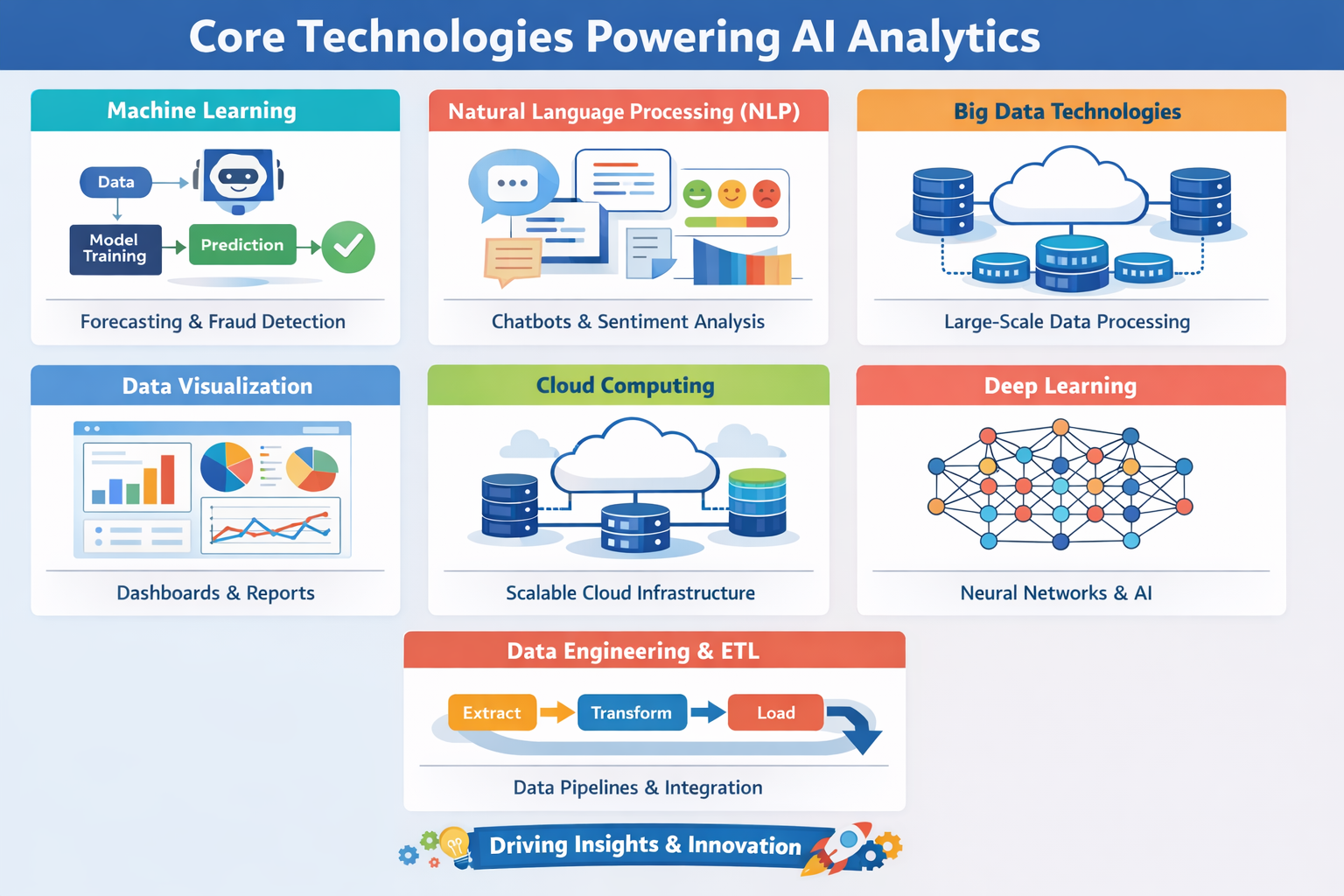
Several basic concepts are behind modern AI analytics platforms:
- Algorithms for machine learning
- Processing natural language
- Pipelines for data engineering
- Data warehouses on the cloud
- Architectures for real-time streaming
Even the best models fail without clean pipelines and organized data. Early steps in scalable AI business analytics projects involve evaluating data quality and the maturity of the architecture, which aligns perfectly with the data maturity model framework.
AI Analytics Use Cases Across Industries
Different industries use AI analytics in different ways, but some common reasons for doing so are:
Online and in-store shopping
Forecasting demand, customising offers, and changing prices.
Services for Money
Finding fraud, rating credit, and making the most use of a portfolio.
Health care
Planning resources and predicting patient outcomes.
Making things
Predictive maintenance and making the supply chain work better.
Technology and SaaS
Predictions about customer attrition and information about how customers use your products.
Companies in all kinds of fields that use AI analytics for business say that their decisions are made faster and their strategies and actions are more in line with each other.
How to Choose the Right AI Analytics Solution for Business
Not every vendor or platform will give you real value. To make good decisions, leaders should think about the following:
- Business Alignment: Does the solution immediately connect to measurable KPIs for business alignment?
- Data Readiness: Can your architecture handle AI workloads?
- Scalability: Does the system you are using have the ability to scale with the growth of the data?
- Governance and Compliance: Are considerations like privacy and security integrated in your system from the start?
- Integration: Will it work well with the systems that already exist?
How HeadToNet Turns AI Analytics into Real Business ROI
HeadToNet focuses on structured analysis, architecture validation, and performance benchmarking to ensure AI analytics investments deliver measurable ROI rather than just experimentation. Organizations that master AI business analytics gain a competitive edge and long-term capability growth. Integrating AI with marketing automation workflows ensures that insights directly drive actions, closing the loop from analysis to execution.
Ready to Move Beyond Dashboards?
Contact Us
FAQs
1. What are AI analytics solutions?
AI analytics solutions use artificial intelligence and machine learning to analyze data, uncover patterns, and deliver actionable insights for better business decisions.
2. How do AI analytics solutions deliver real business value?
They drive revenue growth, reduce costs, improve efficiency, and enhance customer experiences through data-driven insights and automation.
3. Which AI analytics solutions provide the best results?
Predictive analytics, customer segmentation, real-time analytics, anomaly detection, and marketing automation are among the most effective solutions.
4. What is predictive analytics in AI?
Predictive analytics uses historical data and machine learning models to forecast future trends and help businesses make proactive decisions.
5. What challenges do businesses face when implementing AI analytics?
Common challenges include poor data quality, lack of skilled talent, integration issues, and difficulty scaling AI solutions effectively.
StackAudit Offer