Top 10 Data Warehouse Benefits for Better Decisions 2026
.avif)
Modern organizations have one of the most valuable resources in data. However, when information is stored across multiple systems such as CRM software, marketing sites, financial programs, and operational databases, it will be hard to examine and draw valuable conclusions.
It is where a data warehouse would come in handy.
A data warehouse is a centralized repository that collects data from multiple sources to enable the analysis of large volumes of information. An enterprise data warehouse takes this a step further by integrating data across the entire organization, providing a unified view for better decision-making. It helps businesses make smarter decisions by delivering consistent, reliable data.
What is a Data Warehouse Solution?
A data warehouse solution is a centralized system that is meant to accumulate, store, and manage both structured and semi-structured data derived from different operational systems.
A data warehouse is an analytics, reporting, and business intelligence data warehouse, unlike transactional databases that are used to support the day-to-day running of businesses.
Data warehouses are used in organizations that are interested in collecting data across several sources and converting it into actionable information.
Why Businesses Need Data Warehouse Solutions
Modern businesses generate large volumes of data from multiple sources such as CRM systems, websites, marketing platforms, and financial software. A data warehouse solution centralizes this data into one platform, making it easier to analyze and generate insights. This helps organizations improve decision-making, enhance reporting, and support advanced analytics like business intelligence and predictive modeling.
Key Features of a Data Warehouse Solution
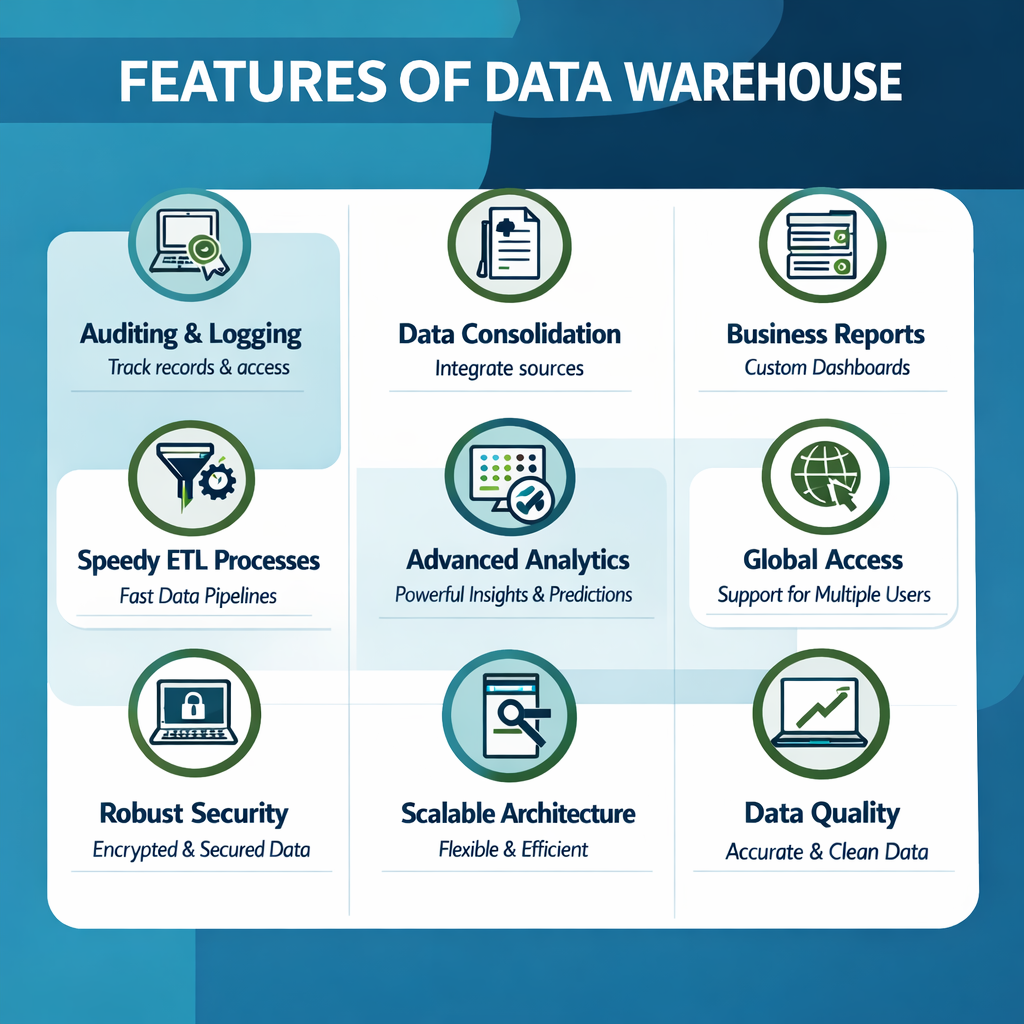
Understanding the features of data warehouse systems helps businesses recognize why they are essential for data-driven decision-making.
1. Centralized Data Storage
The entire data of the enterprise is concentrated in one database.
2. ETL / ELT Data Processing
The data is loaded, transformed, and extracted so that it will be consistent and high-quality.
3. Historical Data Storage
Companies have the ability to study monthly or annual trends.
4. Query Optimization
Data warehouses are used to support high-speed analytic queries more than transactions.
5. Data Governance & Security
Protection of data is achieved through access controls, auditing and compliance mechanisms.
6. Integration with BI Tools
The data warehouses are readily linked to platforms such as dashboards and analytics software.
Top 10 Benefits of a Data Warehouse Solution
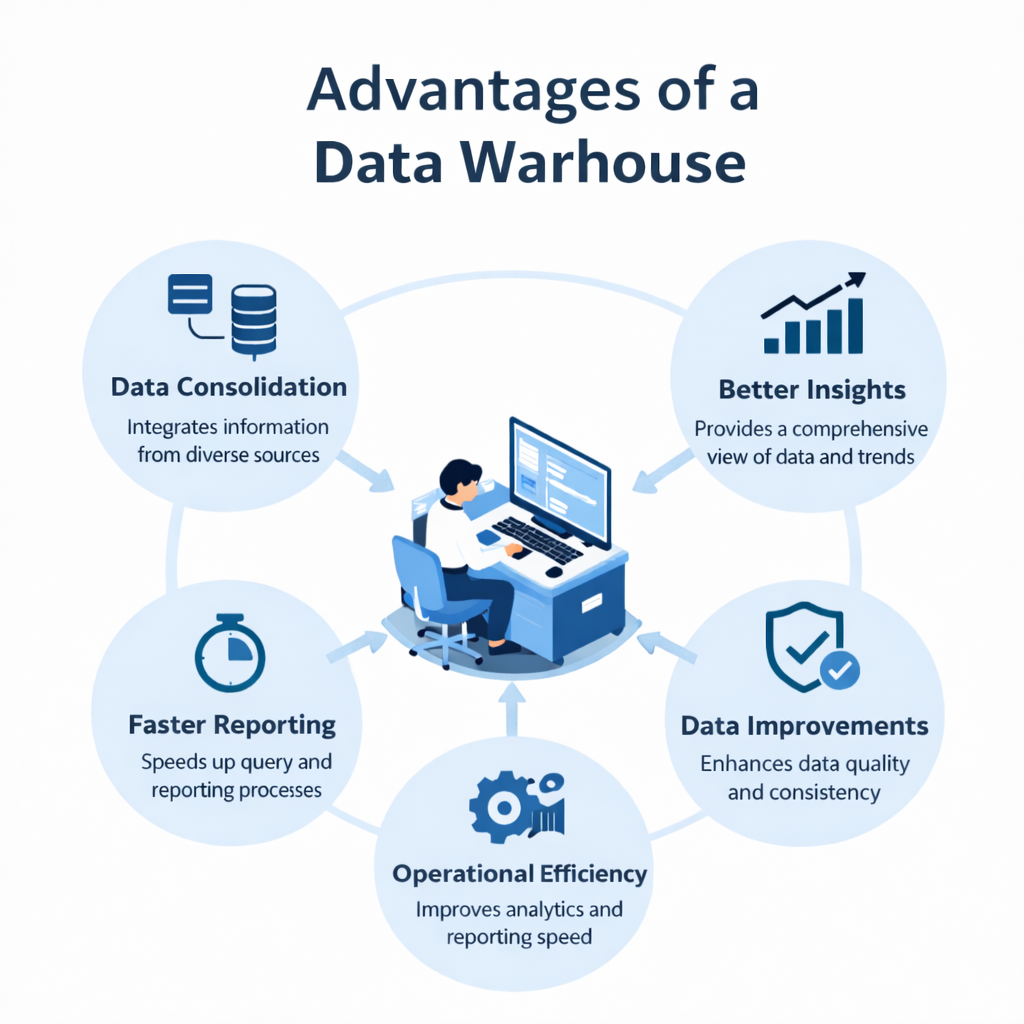
The following are the most significant benefits of a data warehouse system for organizations in any industry.
1. Single Source of Truth
Elimination of data silos is one of the largest advantages of data warehouse. The warehouse is a single trusted source of information instead of teams drawing data on one source, which is disconnected with the other.
Result:
- Consistent reporting
- Reduced data conflicts
- Departmentalised analytics.
2. More Rapid and Intelligent Decision-Making.
Strategic decisions made by executives are based on right data.
Data warehouses enable:
- Advanced analytics
- Real-time dashboards
- Predictive modeling
Centralized data will help decision-makers analyze performance immediately instead of having to wait to obtain manual reports.
3. Better Quality and Accuracy of Data.
Information that is received on various systems is likely to have duplicate, errors, or inconsistencies.
With the help of ETL pipelines, a warehouse provides:
- Data cleansing
- Standardization
- Deduplication
This enhances the credibility of analytics tremendously.
4. Historical Data Analysis
Operational databases normally contain up-to-date data.
A data warehouse holds years of data through which businesses can analyze:
- Market trends
- Customer behavior
- Revenue growth patterns
- Seasonal demand
Past experience is critical in forecasting and strategic planning.
5. High-level Business Intelligence and Analytics.
Contemporary analytical systems are based on centralized data storage.
Data warehouses power:
- BI dashboards
- Data visualization
- Predictive analytics
- Machine learning models and AI.
This enables organizations to change raw data to actionable insights.
6. Enhanced Data Governance and Data Security
Enterprise data involves security which is paramount.
A data warehouse that is well designed has:
- Role-based access control
- Data encryption
- Compliance frameworks
- Audit trails
These characteristics make sure that the sensitive data are secure and yet accessible to be analysed.
7. Growing Data Requirement Scalability.
Companies are producing large amounts of data on a daily basis.
The modern cloud data warehouse solutions offer:
- Elastic storage
- High-performance processing
- Scalable architecture
This allows organizations to manage increasing data volumes without infrastructure limitations.
8. Improved Reporting and Performing.
The conventional functional databases are unable to cope with complicated analysis queries.
A data warehouse will be specially optimized to support reporting loads, which enable:
- Faster SQL queries
- Large dataset analysis
- Concurrent users without any problem in terms of performance.
This greatly enhances team efficiencies in reporting.
9. Better Interdepartmental Cooperation.
Various departments marketing, finance, sales and operations tend to be working with different tools.
A central warehouse makes sure that the entire teams:
- Access the same data
- Operate on regular measures.
- Share insights easily
This enhances co-operation and also reduces misunderstandings that arise due to differing reports.
10. Empowers AI, Predictive Analytics, and Data Science.
The use of AI-driven decision-making is gaining acceptance in today's organizations.
A data warehouse contains the clean and structured data needed in:
- Machine learning models
- Customer segmentation
- Fraud detection
- Demand forecasting
Advanced analytics initiatives are hard to implement without centralized data.
Ready to transform your business data into actionable insights?
Contact Today
Top Data Warehouse Solutions in the Market
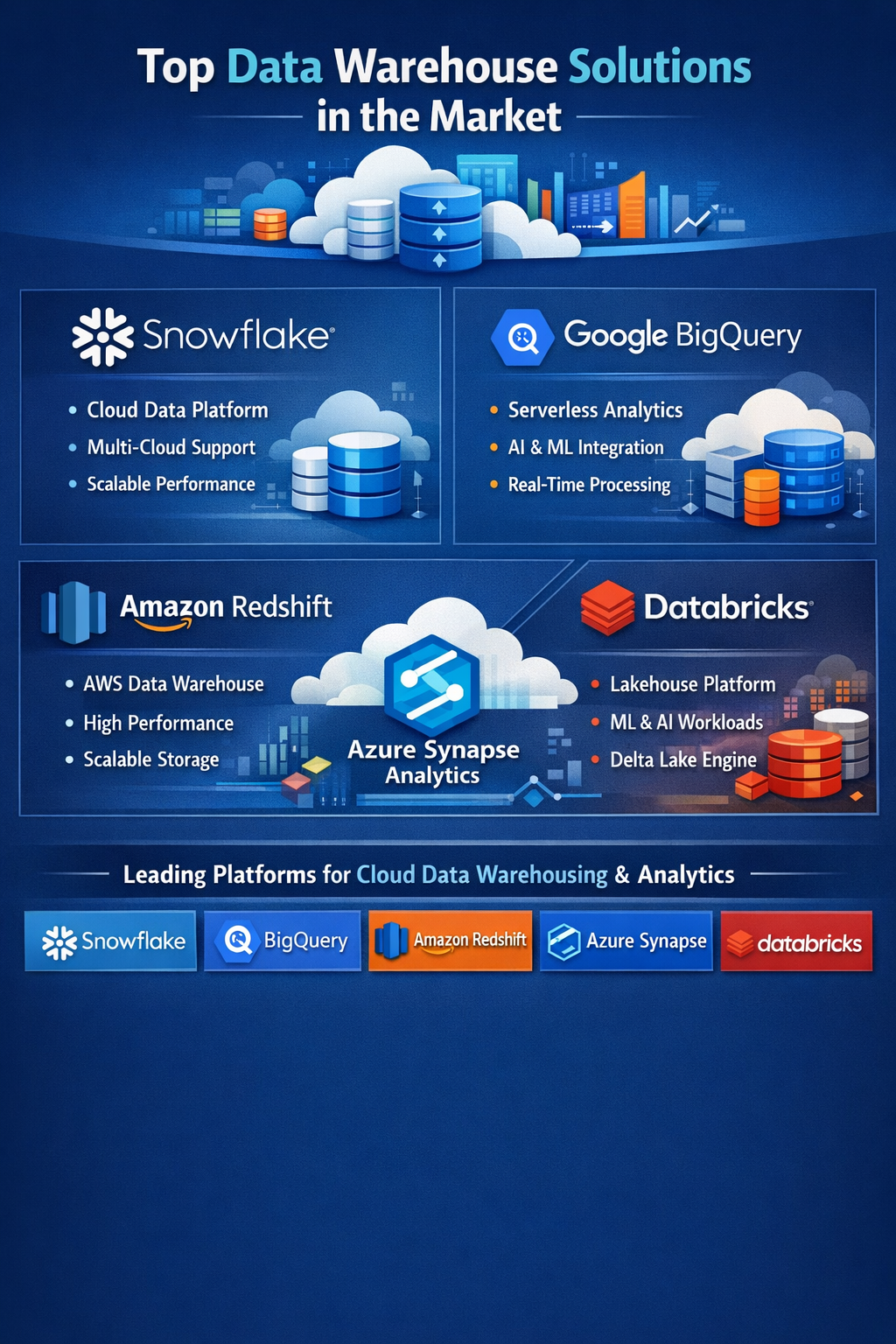
The contemporary data warehousing ecosystem consists of a number of potent platforms. The solutions have offered extensive scalability, sophisticated analytics, and easy compatibility with business intelligence tools.
1. Snowflake
One of the most trending cloud-native data warehouses is Snowflake. It also provides a high level of scalability, high query response, and adaptability in data sharing.
2. Amazon Redshift
Developed by Amazon Web Services, Redshift is an effective cloud data warehouse that is compatible with the analytics and integration of the AWS ecosystem, which is optimized to support large-scale analytics.
3. Google BigQuery
Google BigQuery is a fully managed serverless data warehouse that enables organizations to execute extremely fast SQL queries over large volumes of data.
4. Microsoft Azure Synapse Analytics
Azure Synapse is a collection of data warehousing and big data analytics integrated into a single platform, which can be fully integrated into the cloud ecosystem of Microsoft.
5. Databricks Lakehouse Platform
Databricks is a unified data warehouse and data lake architecture that enables companies to handle both structured and unstructured data on a large scale.
6. IBM Db2 Warehouse
IBM Db2 Warehouse offers a highly secure, fast, and high-performance enterprise-level analytics.
7. Teradata
Teradata is an established enterprise data warehouse system that is associated with extremely large workloads of analytics.
These are the modern data warehouse programs that assist organizations in handling the increasing amount of information and in the process making analytics quicker and enhanced business insight.
Common Uses of Data Warehouse Solutions
The knowledge about the applications of data warehouses assists in explaining its value in the real world.
Sales Analytics
Monitor sales performance, increase in revenue, and acquisition of customers.
Marketing Intelligence
Measure campaign performance and customer interaction.
Financial Reporting
Establish true financial statements and profitability reports.
Customer Insights
Know the purchasing trends and behaviour of customers.
Supply Chain Optimization
Track inventory, logistics effectiveness and demand prediction.
Cost of Data Warehouse Implementation
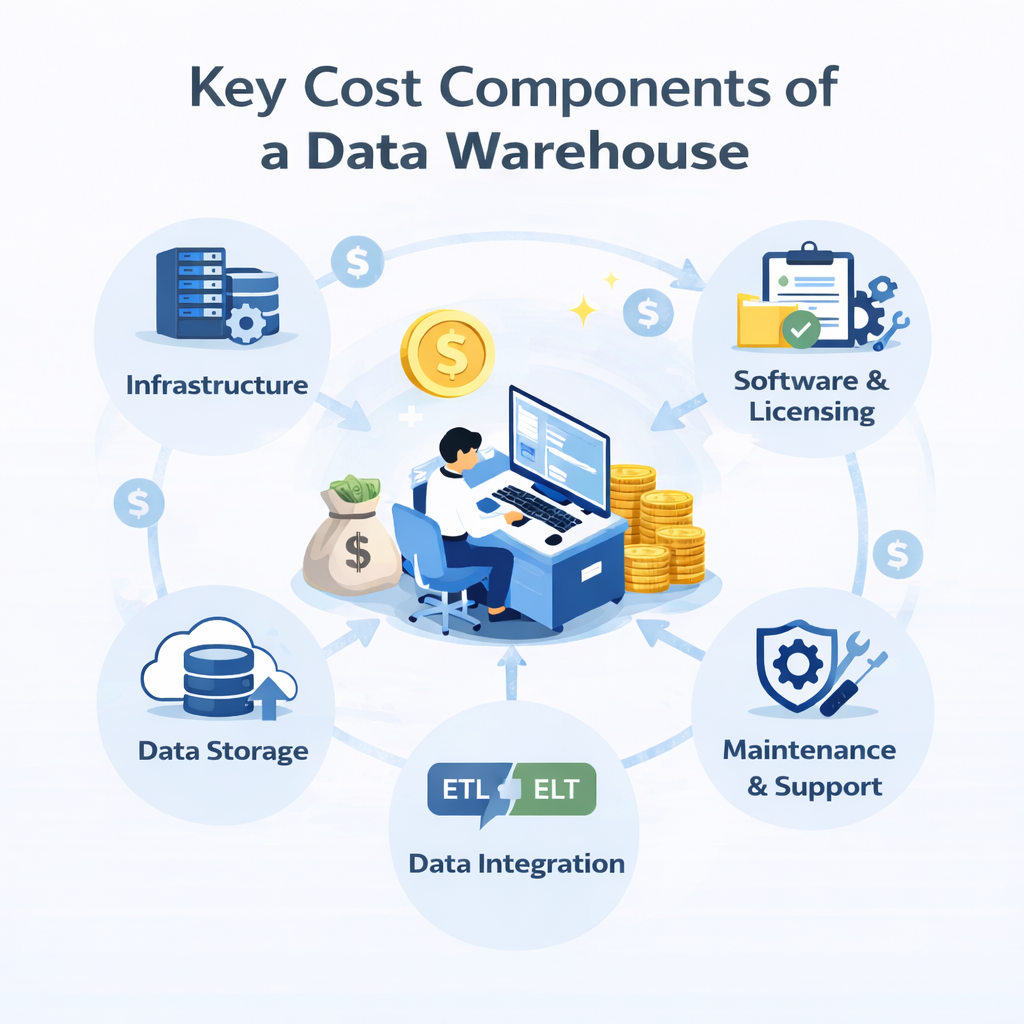
While the advantages are significant, organizations must consider the cost of data warehouse implementation.
Key Cost Components
- Infrastructure Costs
- Cloud storage
- Compute resources
- Cloud storage
- Data Integration Tools
- ETL/ELT pipelines
- Data ingestion tools
- ETL/ELT pipelines
- Data Modeling and Development
- Schema design
- Pipeline development
- Schema design
- Maintenance and Operations
- Monitoring
- Data governance
- Optimization
- Monitoring
Typical Cost Range
Implementation costs vary depending on the scale of the organization:
Cloud-based solutions significantly reduce upfront infrastructure costs.
Why Choose HeadToNet for Data Warehouse Solutions
Implementing a data warehouse requires the right strategy, architecture, and technical expertise.
HeadToNet helps businesses design and implement scalable data warehouse solutions that transform raw data into meaningful insights.
With expertise in data integration, cloud platforms, and advanced analytics, HeadToNet enables organizations to centralize their data, improve reporting performance, and maximize the benefits of modern data warehousing technologies.
From infrastructure planning to implementation and optimization, HeadToNet ensures businesses can make smarter decisions and drive long-term growth.
Transform your business with actionable insights.
Contact HeadToNet
StackAudit Offer