Best CRM Options for Small Business Growth
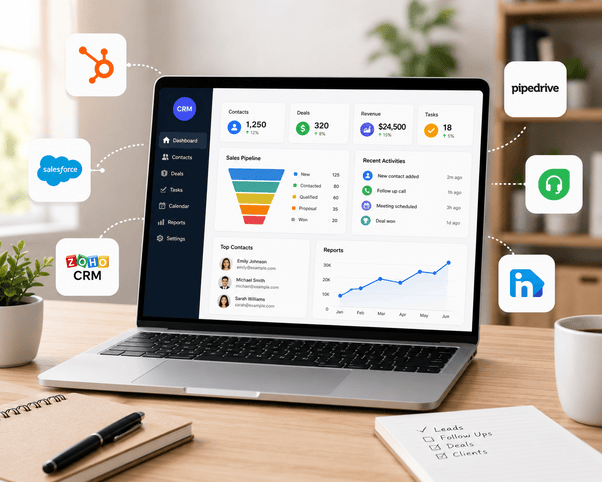
For most small businesses, HubSpot CRM is the best starting point especially when compared to the high custom CRM development cost that comes with building a CRM from scratch. It’s free for up to 2 users with unlimited contacts, pipeline tracking, and email integration. If you need deeper customization at low cost, choose Zoho CRM. For pure sales pipeline focus, Pipedrive wins. If you're a solo operator or tiny team, Less Annoying CRM ($15/user flat) is the simplest and most affordable paid option. Only consider Salesforce if you plan to scale past 50 employees and want to avoid a painful CRM migration later.
What Does a Small Business Actually Need from a CRM?
A spreadsheet works fine for 20 contacts. But somewhere around 50 active leads, things start slipping follow-ups go cold, deals fall through the cracks, and your sales process lives in someone's head instead of a shared system. That's when a CRM pays for itself.
Small businesses don't need the same things enterprises do. You need: fast setup (hours, not weeks), affordable pricing (ideally under $20/user/month to start), a clean pipeline view, automatic email logging, and mobile access. Complex AI forecasting and custom object models can wait.
The 6 Best CRM Tools for Small Business (2026)
1. HubSpot CRM
Best Free Option | Free tier available Starting price: Free · Starter from $20/user/month
The most generous free CRM on the market. The free tier includes unlimited contacts, deal pipelines, email tracking, a meeting scheduler, live chat, and basic reporting with no time limit. TechRadar and Zapier both rank it #1 for free small business CRM. The catch: costs climb sharply once you need automation or marketing tools.
Pros:
- Genuinely useful free plan (not a bait tier)
- 1 million contacts on free
- Strong email and marketing integrations
- Best for content-led businesses
Cons:
- Price jumps fast after free tier
- Overkill if you only need basic pipeline
- Professional plan is expensive for small teams
2. Zoho CRM
Best Value | Free for 3 users Starting price: Free · Standard from $14/user/month
The most feature-rich CRM at its price point. Custom workflows, multi-channel communication, AI-powered lead scoring (Zia), and deep integration with 40+ Zoho apps (Zoho Books, Desk, Campaigns). If your sales process doesn't fit standard templates, Zoho bends where others won't. The trade-off: steeper learning curve and a UI that can feel cluttered.
Pros:
- Enterprise features at small business prices
- Full Zoho ecosystem (Books, Projects, Campaigns)
- Deep customization fields, layouts, workflows
- Zoho One bundle ($45/user) = entire business stack
Cons:
- UI feels dated vs. newer tools
- Zia AI less reliable with small datasets
- Support slow on lower tiers (email only)
3. Pipedrive
Best for Sales Teams | No free plan Starting price: Essential from $14/user/month
Built entirely around the visual sales pipeline. If your team lives in deals not marketing, not support Pipedrive is the cleanest tool available. It forces you to define the next action on every deal, which is exactly what small sales teams need. Not suited for businesses that need marketing automation or customer support in the same tool.
Pros:
- Best visual pipeline UX in the market
- Fast adoption teams use it within hours
- Strong for high-volume transactional sales
Cons:
- No free plan
- Weak on marketing and customer support
- Limited if you need multi-channel comms
4. Less Annoying CRM
Best for Solo / Micro Teams Starting price: $15/user/month flat, no tiers
Does exactly what the name says. One price, every feature, no upgrade pressure ever. PCMag's favorite for ultra simplicity. If you're a freelancer, consultant, or a team of 1–5 moving off a spreadsheet for the first time, this is the easiest possible starting point. No bloat, no learning curve, no hidden gates.
Pros:
- Flat pricing no tier confusion
- Easiest onboarding of any CRM listed
- All features included at one price
Cons:
- Very limited automation
- Not built to scale beyond ~20 people
- No marketing or support features
5. Salesforce Starter Suite
Best for Future Scaling Starting price: From $25/user/month
Only worth it if you're planning to grow past 50 employees. The reason: switching CRMs at that stage typically costs $10,000–$50,000 in migration, consulting, and downtime. If you start on Salesforce, you never have to switch the platform grows with you all the way to enterprise. The Starter tier is genuinely limited (no workflows, no custom objects), but the growth path is unmatched.
Pros:
- 7,000+ apps in AppExchange marketplace
- Einstein AI for predictions and automation
- No painful migration as you scale
Cons:
- Starter tier is significantly limited
- Most expensive per user on this list
- Steeper setup vs. HubSpot or Pipedrive
6. Capsule CRM
Free up to 2 users Starting price: Free · Starter from $18/user/month
Designed for professional services consultants, agencies, law firms. Setup takes hours, not days. The interface is clean enough that a new user can find a contact, check interaction history, and update a pipeline stage within minutes of first login. Limited automation and reporting, but for relationship-led businesses, it's exactly right.
Pros:
- Fastest onboarding on this list
- Clean, focused UI nothing unnecessary
- Great for agencies and service businesses
Cons:
- Limited automation depth
- Starter plan expensive for what you get
- Not suited for complex multi-team operations
Quick Comparison Table
Which CRM Should You Pick? (Decision Guide)
- Zero budget, start today → HubSpot Free
- Deep customization at low cost → Zoho CRM (Standard)
- Pure sales team, visual pipeline → Pipedrive
- Solo or team of 1–5, just the basics → Less Annoying CRM
- Planning to grow to 50+ employees → Salesforce Starter
- Agency, consultancy, or service business → Capsule CRM
Frequently Asked Questions
What is the best free CRM for small business?
HubSpot CRM is the best free option for most small businesses. It offers unlimited contacts, deal pipeline tracking, email integration, meeting scheduling, and live chat all at no cost. The free tier doesn't expire and genuinely covers the core needs of most teams under 10 people.
What's the simplest CRM for a small team or startup?
Less Annoying CRM is the simplest paid option one flat price of $15/user/month, every feature included, no tiers or upgrade prompts. For free options, Capsule CRM has the fastest onboarding and the cleanest interface for teams new to CRM software.
Is HubSpot good for small businesses?
Yes HubSpot is excellent for small businesses that are content-led or have marketing and sales under one roof. The free CRM is genuinely useful, not a stripped-down bait tier. The risk is cost: once you outgrow the free plan and need automation or advanced reporting, pricing escalates quickly.
How much does a small business CRM cost?
Expect to pay $0–$15/user/month for basic CRM with a free tier (HubSpot, Zoho, Capsule). Mid-tier paid plans run $14–$25/user/month and cover most small business needs. Enterprise-grade platforms like Salesforce start around $25/user but scale to hundreds. Most small businesses of 2–10 people can start free and stay there for 12–18 months.
Should a small business use Salesforce?
Only if you're planning to scale significantly. Salesforce Starter is limited and expensive compared to HubSpot or Zoho at the same stage. The reason to start with Salesforce early is to avoid a painful CRM migration later switching platforms at 50–100 employees typically costs $10,000–$50,000 in time and consulting.
What CRM do most small businesses use?
HubSpot and Zoho CRM are the most widely used among small businesses in 2026. HubSpot leads among marketing-driven businesses; Zoho leads among budget-conscious teams that need customization. Pipedrive is the top choice among pure sales teams who prioritize pipeline management over everything else.
StackAudit Offer