Retail Business Intelligence Solutions: Benefits, Use Cases & Real Examples
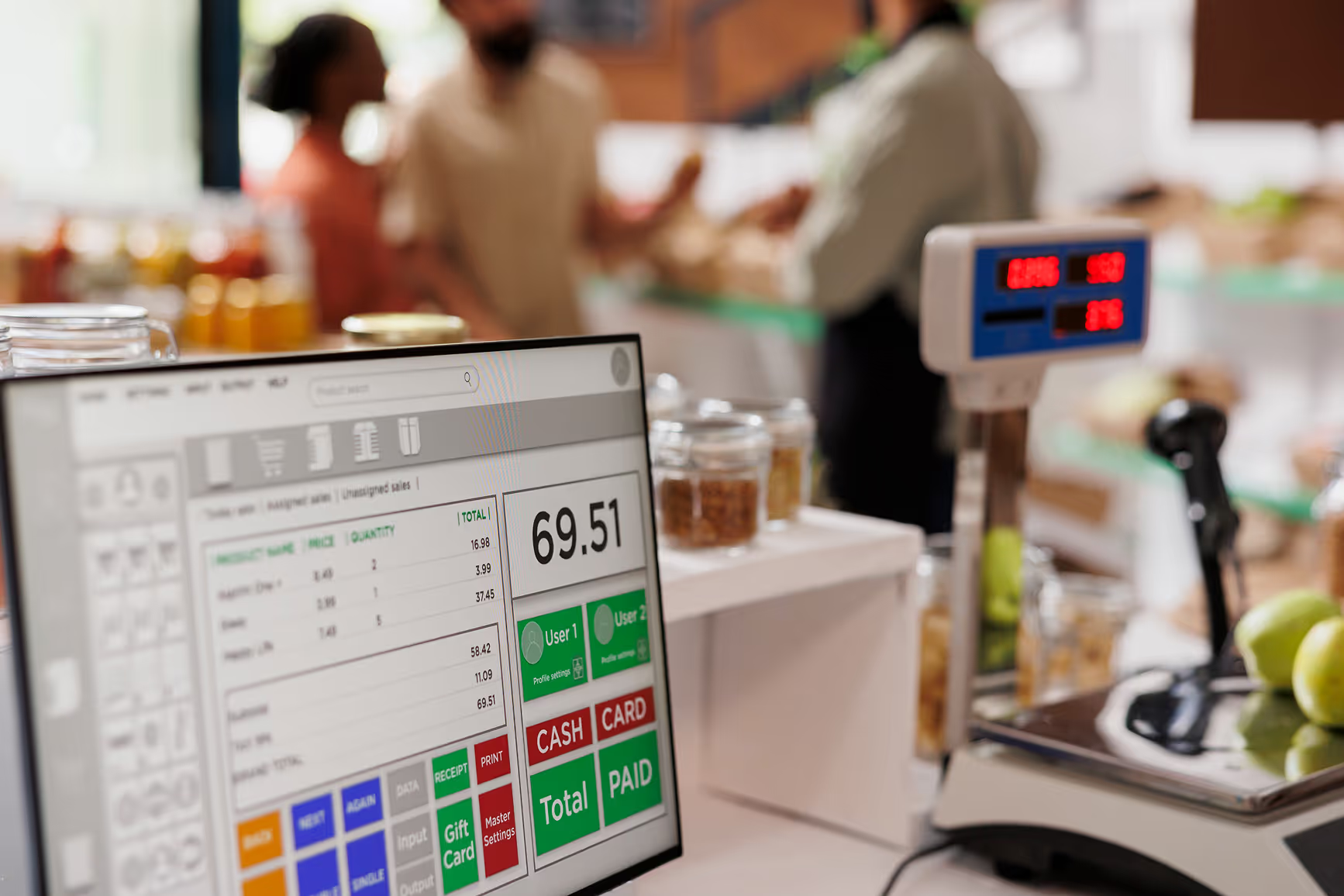
The retail sector generates large volumes of information related to sales, customers, stock, and marketing channels. Turning this data into meaningful insights is where business intelligence in the retail sector becomes essential. Modern retail business intelligence solutions help retailers transform raw data into actionable insights that improve performance and decision-making.
Retailers increasingly use an AI analytics solution alongside BI tools to uncover trends, automate insights, and improve decision-making. By leveraging business analytics in the retail industry, businesses can optimize pricing, manage inventory efficiently, and deliver better customer experiences.
In this guide, we explore the benefits, use cases, tools, and real-world examples of business intelligence in the retail industry.
What is Business Intelligence in the Retail Sector?
Retail business intelligence refers to the use of data analytics tools and technologies to collect, process, and organize retail data in order to improve decision-making. Retail BI solutions include data from various sources such as POS systems, eCommerce platforms, CRM systems, and supply chain systems.
Retailers can use these insights to:
- Monitor sales performance
- Monitor customer buying patterns.
- Efficient inventory management.
- Enhance marketing policies.
- Predict demand trends
Unlike traditional reporting, modern retail business intelligence solutions provide real-time insights through dashboards, predictive analytics, and data visualization. Many retailers also explore the long-term data warehouse benefits of centralized reporting systems to improve analytics accuracy and business scalability.
Key Benefits of Business Intelligence Solution in Retail
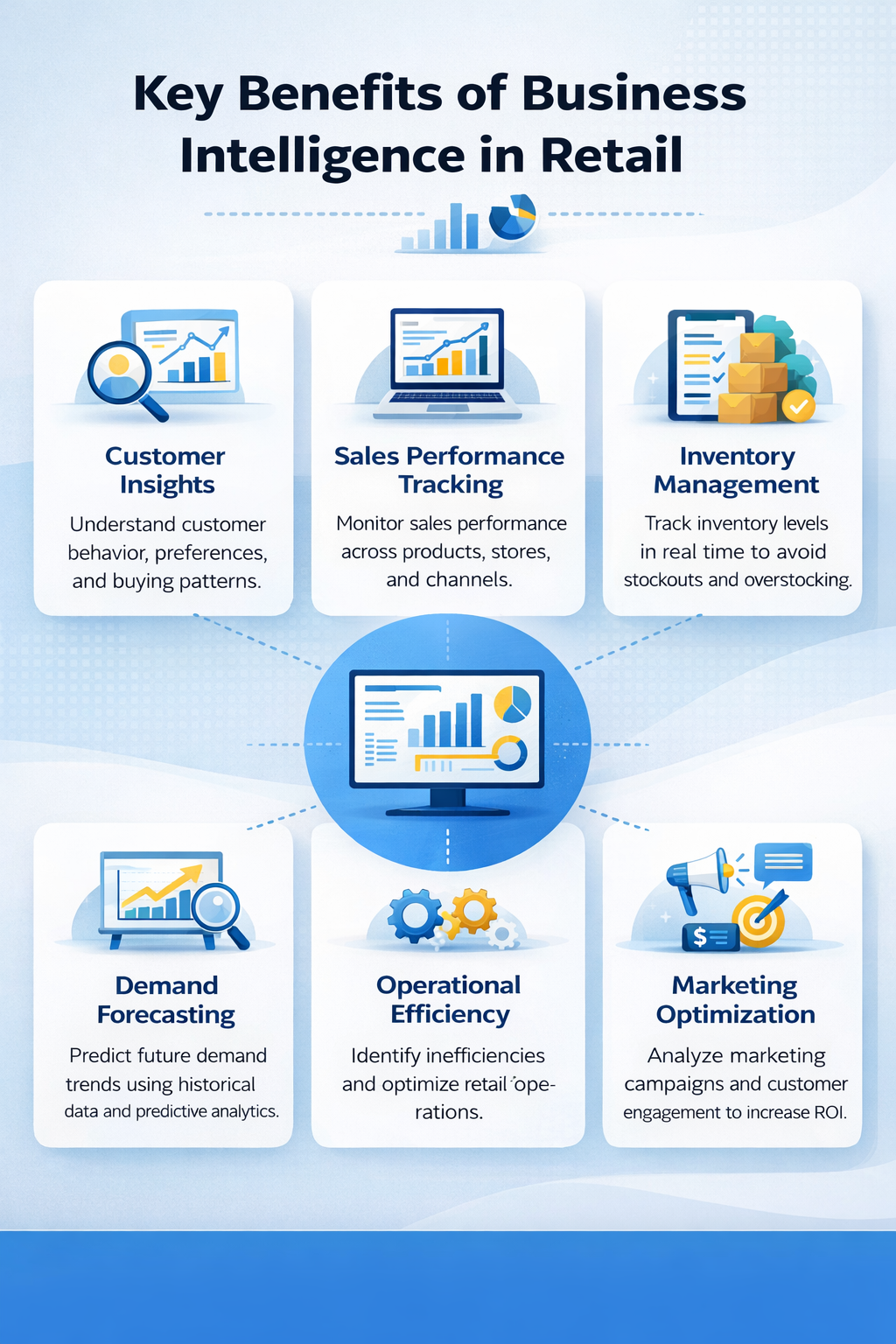
Implementing business intelligence in the retail sector provides several advantages for modern retailers using retail BI solutions.
Better Customer Experience
BI tools examine customers' buying behavior patterns and preferences. These insights allow retailers to run promotions, make product suggestions, and optimize the shopping experience.
Enhanced Inventory and Supply Chain Management
Retailers can monitor inventory levels in real time, reducing stockouts and overstocking. BI systems can also be used to predict product demand and streamline supply chain operations.
Analytics-Enabled Marketing Campaigns
Retailers can also analyze marketing campaign performance and determine which channels deliver the highest returns using BI analytics.
Optimized Product Pricing
The business intelligence tools help retailers analyze competitors' prices and demand trends so they can strategically adjust their prices.
Competitive Market Analysis
Retail BI enables companies to analyze competitors' strategies and market trends, helping them stay current in a competitive retail environment.
Growth in Retail Profitability
Overall, retail business intelligence solutions improve efficiency, decision-making, and profitability while supporting smarter operational planning through practical business management processes examples across retail operations.
Power Your Retail Intelligence with HeadToNet
The successful implementation of business intelligence requires expertise in analytics and scalable systems. HeadToNet helps retailers build advanced retail BI solutions that transform complex data into real-time insights through customized dashboards and analytics platforms.
HeadToNet enables businesses to unlock the full potential of their data and make smarter decisions in a shorter period of time by integrating multiple retail data sources to create real-time dashboards.
Ready to turn your retail data into actionable insights?
Contact Us
Key Retail Metrics and KPIs Tracked with Business Intelligence
BI dashboards in retailing track key performance indicators to help retailers measure success.
Sales Performance Metrics
Sales data helps retailers examine revenue growth, product demand, and seasonal patterns.
Customer Lifetime Value
Customer lifetime value (CLV) is used to determine the amount of revenue that a business can expect from a particular customer.
Inventory Turnover
This ratio indicates the rate of inventory turnover and replacement, and helps retailers control inventory.
Conversion Rate
The conversion rate is used to determine the percentage of visitors who purchase the item, and it helps retailers assess how well marketing and the website are performing.
Average Order Value
Average order value (AOV) shows the average amount that customers have to spend in order to buy products, and businesses can use AOV to make pricing and promotional decisions.
Business Intelligence Use Cases in Retail
Retail firms use retail business intelligence solutions in multiple ways:
Consumer Insights and Customer Behavior
The retailers examine the customer's buying history and browsing behavior in order to learn about the buying patterns and preferences.
Optimization of Product Assortment
BI tools assist retailers in establishing the best-performing products and making necessary changes to their product mix.
Promotion analytics and Retail Pricing
The retailers will be able to examine promotional campaigns and pricing strategies to maximize profits and attract customers.
Inventory Optimization and Supply Chain
Business intelligence assists retailers in tracking supply chain performance, detecting inefficiencies, and minimizing operational costs.
Store Performance Location Intelligence
The retailers are able to analyze the performance of stores in terms of geographical location, demographics of the customers, and foot traffic.
Predictive Analytics Sales Forecasting
Predictive analytics enables retailers to predict the demand, inventory, and seasonal sales fluctuations.
Business Intelligence in Retail Industry Case Study
One of the fashion retailers deployed a BI platform to enhance the sales forecasting as well as inventory management.
Case Study: Fashion Retailer Sales Forecasting with the help of BI
Problem:
The retailer also had poor demand forecasting, resulting in frequent stockouts and overstocking.
Solution:
The organization installed a business intelligence system that incorporated sales information, stock levels, and customer buying trends.
Results:
- Better predictability of demand.
- Reduced inventory costs
- The availability of more products and more customer satisfaction.
The given case study on business intelligence in the retail industry demonstrates the way in which data-driven insights can be used to transform the operations of the retail industry.
Essential Data Sources for Retail BI Solution
Retail BI systems combine data from various sources to create insights.
POS Systems
Point-of-sales systems offer real-time transaction data.
CRM Platforms
Customer relationship management systems are used to monitor customer interaction and purchase history.
E-commerce Platforms
Online retail stores provide information on web traffic, conversion rates, and online sales.
Marketing Automation Tools
Marketing channels allow the monitoring of campaign performance and customer interaction parameters.
Supply Chain Systems
SCM systems track inventory movement and performance.
IoT and Smart Retail Sensors
The IoT and smart sensors provide real-time information on customer movement, shelf availability, and store operations.
Top Business Intelligence Tools for Retail Businesses

The retail industry has used several BI tools.
Microsoft Power BI
Power BI offers effective data visualization and real-time dashboards to help retailers analyse sales and customer data.
Tableau
Tableau also provides advanced data visualization features that enable retailers to understand complex data much more easily.
Looker
Looker is a solution that helps retailers navigate data through interactive dashboards and robust analytics.
Qlik Sense
Qlik Sense employs associative analytics to enable retailers to uncover hidden trends and relationships in their data.
Google Data Studio
Google Data Studio enables retailers to design reports and dashboards that are fully scalable across a variety of data sources.
Conclusion
Business intelligence has become a critical tool for modern retailers competing in a data-driven market. By leveraging business intelligence in the retail sector, businesses can analyze customer behavior, optimize inventory, improve marketing strategies, and make informed decisions.
As technology continues to evolve, retailers that adopt advanced BI solutions and business analytics will gain a significant competitive advantage and drive long-term growth.
Looking to implement business intelligence in your retail operations?
Talk to Our Expert
StackAudit Offer